
A Locally- Run Solar Solution
We are developing community solar on commercial rooftops across Red Hook, Brooklyn with an ownership and governance structure that maximizes benefits to local residents and businesses. Through public engagement, collective-local ownership structures and an equitable business model, this initiative embodies Red Hook’s post-Super Storm Sandy community vision for climate adaptation and a low-carbon future. Benefits to low-and-moderate income residents are the heart of this plan. What makes Red Hook Community Solar special? If you’re not able to have a solar system on your roof, you can still join this program and get the benefits of local solar power generation – lower cost, lower carbon, plus benefits for the whole community, including jobs. How can I get involved? As a building owner, you can host our rooftop solar, as a local resident, you can help us design the program and become a participant, as a jobseeker you can receive training to join the solar industry.
What is Community Solar?
Community Solar allows New Yorkers to reduce energy costs by sharing a solar energy system. With community solar, participants can go solar without installing anything on their own roof and with guaranteed savings!
NYCHA
How is NYCHA included in this initiative? We plan on recruiting workforce trainees from local NYCHA developments. NYCHA has its own separate solar initiative where they are planning on getting solar on their developments over the next few years.
How Can I Join the Initiative?
The project is currently in the Pre-Development phase. Our team is busy searching for solar host sites and preparing for general community outreach.
Solar Host Site Outreach
The project is carrying out local building owner outreach to find viable sites to place the solar panels through our technical assistance services.
If you’re a building owner with 5000+ sq ft of roof space that’s interested in becoming a host site, see below for more information.
Are you a building owner?
Collective/Local Ownership Structures
Community Development Process: The team is gathering local resident input for the community solar project’s ownership, financing, and governance structure.
Do you live in Red Hook?
Solar Host Site Benefits
Support a Community-Driven Renewable Energy Project
Host the solar energy systems that will bring renewable energy, jobs, and bill savings to local residents.
Go Solar At No Cost
Building owners can install solar energy on their roofs at no cost. All the feasibility and development activities are funded by this initiative.
Get Paid For the Use of Your Roof Space
Host sites can receive a lease payment or reduced energy costs in exchange for hosting the solar energy systems.
Maintenance is Off Your Hands
The construction and maintenance of the solar energy systems will be handled by the Red Hook Community Solar Initiative team, and not the building owner.
The Vision
Pre-Development
By Mid-2022:
- Recruit local building owners to host the solar arrays
- Developing community-led ownership model with community input
- Recruit financing, installation, and other necessary project partners.
Phase I Development
By Early-2023:
- Develop at least 1 MW of community solar on Red Hook rooftops with a community-oriented ownership model.
- Reduce energy costs for at least 400 local households, mainly low-income residents.
- Complete a workforce training program for residents seeking to grow their solar career opportunities.
- Develop a robust pipeline for future projects in Red Hook to join the initiative in future phases.
- Low income households reap the financial benefits of the green economy.
Replicability & Community Benefits
By Late-2026:
- Clear Replicability: We’re creating a roadmap for building owner engagement and community-based planning for community solar projects in similar communities
- Low income households reap the financial benefits of the green economy.
Check Out Our Partners!
RETI Center
Resilience Education Training and Innovation [RETI] Center is a non-profit organization, founded in 2015, dedicated to building strength in people through resilience-focused economic development. Working with low-lying coastal communities, like Red Hook, RETI Center focuses on the integration of education and job creation, social justice and climate change mitigation.
The Solar Youth Fellowship
- A workforce development and employment opportunity hosted by RETI, where young adults from low-income households in Red Hook shadow the solar feasibility process, learn the technical aspects of solar development and provide project support.
- Sign Up Here to Receive More Info! [intake form]
Here Comes Solar
Here Comes Solar is a program of Solar One that provides solar technical assistance to multi-family buildings and community solar enrollment.
NYSERDA
We have already received grant funding from the New York State Energy Research and Development Authority to get this project off the ground!
Goals of the Red Hook Community Solar Initiative
Prioritizing Access for Low Income Households
Subscriptions for the project will be offered to residents and businesses of Red Hook, focusing on access for low income and affordable housing residents, however additional subscriptions will be offered to neighboring communities.
Workforce Development
RETI Center is partnering with local organizations (such as Red Hook Initiative, South Brooklyn Community High School, Solar One, Brooklyn Solar Works) to provide training opportunities in solar PV and green construction for Red Hook residents.
Community-First Ownership Structure
We are developing a community-first business model maximizing savings for low income households. This non-traditional ownership option will be made possible through recruiting equitable financing partners and local capital, such as direct investment by owners of host sites.
A Clear Road for Future Projects
We are creating a replicable process for expanding solar on the abundant industrial roofscapes of the neighborhood, each owned through a community-based structure by local residents. We are building up our vision for a stronger, more resilient, low-carbon future for Red Hook to fight our mounting environmental justice challenges.
Tell Me More About Red Hook
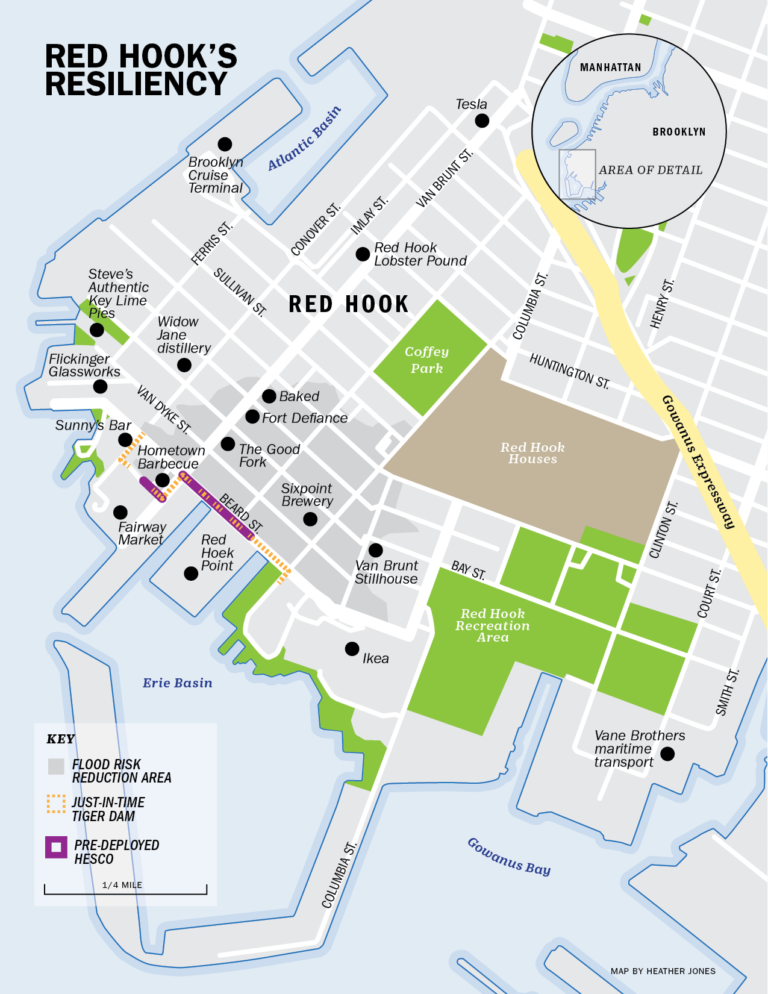
Where Is Red Hook?
Historical Timeline (in a Nutshell)
Originally home to the Lenape peoples, Red Hook was one of the earliest areas in Brooklyn to be colonized. The neighborhood has a long history of maritime industrial buildings, since the late 1790s. The area was named for its red clay soil and the hook shape of its peninsular corner of Brooklyn that projects into the East River. The neighborhood is undergoing rapid changes with both gentrification and the replacement of historic maritime waterfront buildings with newer, transit and shipping oriented mega facilities. Red Hook lacks strong building integrity and is at risk for future natural disasters, as was exemplified with the destruction of Hurricane Sandy.
Read an expanded timeline written by local residents.
Explore the local history of justice, race and environment on your mobile device.
A Home for the People
Red Hook is home to the NYCHA Red Hook Houses – the largest public housing development in Brooklyn, which accommodates 6,000+ people.
One in three residents spend 35% + of their income on rent.
NYCHA has its own separate solar initiative where they plan to have solar on their developments over the next few years. Join us in asking NYCHA to include the Red Hook Houses in their next round of projects!
A Frontline Community Risking Climate Change
Today, Red Hook is highly at risk of climate change, risking flood damage due to sea level rise and other natural disasters.
See the Flood Map here.
For instance, Hurricane Sandy damage from 2012 is still yet to be repaired in many parts of the community. Red Hook is one of the few areas left in New York City with a power grid that is above ground. Our decrepit system has led to dangerous brownouts and power outages during peak need periods. Following Super Storm Sandy, power didn’t return to some areas of the neighborhood for weeks, or months in some cases. Local, renewable power can change that.
Read more about the environmental justice context here.